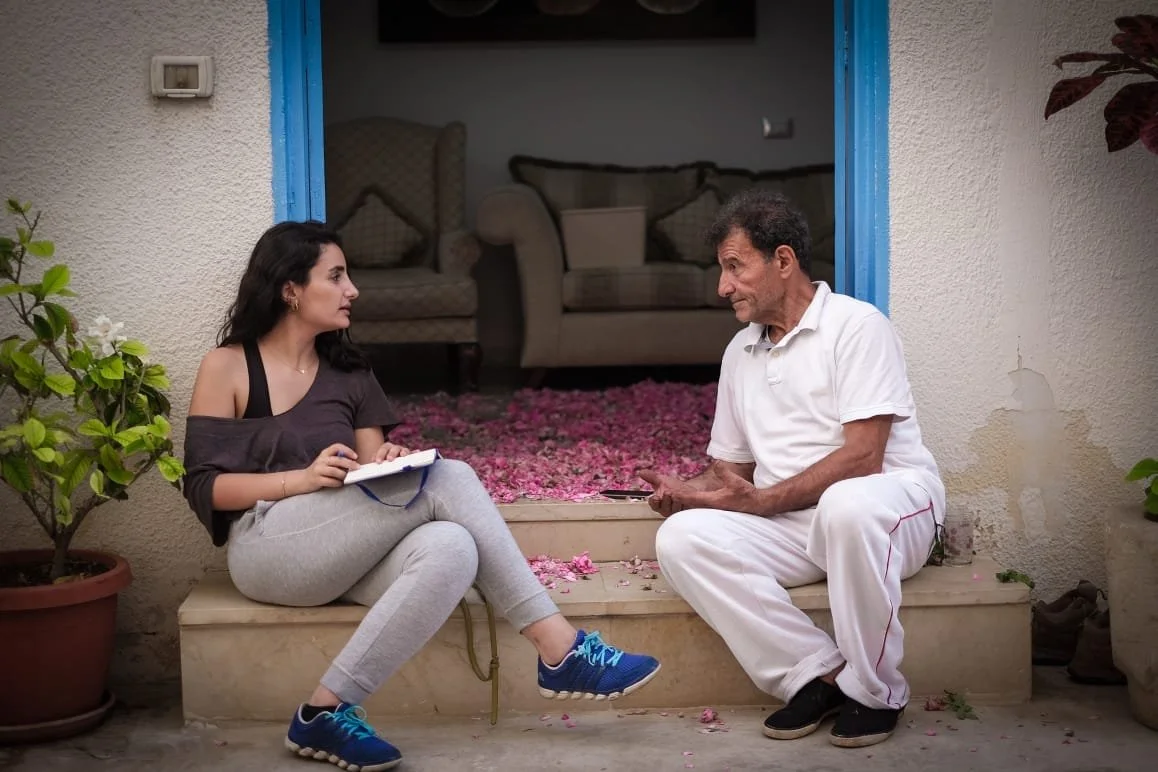
Majaz is a magazine that produces and publishes digital content based on narrative journalism, ethnographical methods and instant photography. It tells the stories of people and their experiences that are missing from the media landscape—whether intentionally or not—with the aim of raising social issues and documenting the everyday lives and cultural dimensions of individuals and communities.
Majaz practices journalism built on weaving relationships between journalists and people, where subjects aren't merely names mentioned in articles, but part of a community where experiences intersect, emotions are documented, and the different ways they perceive reality are recorded. One issue after the other, Majaz aims to build an archive of people's feelings, because "history doesn't just create emotions, emotions create history too."
Manifesto
There is no memory without narrative. In raising issues, Majaz goes beyond documenting events themselves, not because documenting events isn't important, but because that's already the function of daily newspapers and news websites. Instead, Majaz tells the stories of people in the aim to fulfill one of the most vital purposes of narrative writing: enriching collective memory.
Majaz pays close attention to people's emotions based on the conviction that these feelings form a collective consciousness—and unconsciousness—that shapes what's to come and helps us understand what has passed. Majaz aspires to build an archive that preserves the emotions, visions, and questions that outlive those who experienced them, serving as a social observatory that can be revisited at any time to understand how people felt during a particular period in this country's life.
Majaz meets people in their real and imagined homes: the homes they return to in the evening and the homes they carry with them everywhere. It listens to them, then arranges their stories, narrates them, and preserves them in written texts and in the instant photographs it takes of them.
Majaz in the Lebanese Home
In Arabic, "majaz" means crossing over. It's also a passageway or corridor. In architecture, majaz refers to the hallway that connects the entrance door to the courtyard in the traditional Arab home, easing the transition from the rooms of the house to the street while maintaining the privacy of its inhabitants, so that the passage from private to public isn't abrupt.
Majaz aims to politicize lived reality, to be the hallway in our Lebanese home, and to reweave the connection between private and public space, between the intimate and the accessible, between the individual and the collective. It seeks to liberate discussion about the direct and indirect impact of political and social issues on everyday, ordinary life.
Majaz aspires to return the human being—with their emotions, concerns, and aspirations—to the heart of journalism, viewing journalism as a means of capturing daily life and as a practice that observes people's lives in their details.
Who Tells People's Stories?
At the major turning points that determine the course of history, as in ordinary days, newspapers and media outlets are preoccupied with searching for big headlines: declaring wars and peace, refugee numbers and the scale of losses, passing laws and their implementation and then their repeal. At the major turning points that determine the course of history, who tells people's stories? Who conveys the question, the feeling, the experience? Majaz takes on the task of pulling experiences from darkness into light and connecting them with other intersecting experiences.
And amid the focus on conveying the big picture and panoramic scenes, who takes small photographs for people to keep in a drawer or wallet pocket, or at best, display in a frame? Preferring the tangible over the digital, Majaz relies on instant photography for its small frame and high aesthetic quality, despite its simple technical capabilities. Majaz considers the instant photo frame a window onto people's stories in their private spaces, and a window through which people look out onto the public sphere.
Who's behind Majaz?
I published my first article in a local newspaper in Tripoli, northern Lebanon. At the time, I considered journalism practice for literary writing: publish some articles first, then move on to publishing books. But I continued with journalism, meeting people in their spaces and writing about them.
For more than ten years, I've worked in Arab and Francophone journalism, publishing articles and investigative pieces in newspapers including L'Orient-Le Jour, Al-Araby Al-Jadeed, Al-Modon, and As-Safir. I've also worked as a communications and media consultant for several Lebanese and Arab organizations, and today I live in the US.
While covering political, social, and environmental events and issues, I tended to move away from the heart of the action where media outlets crowd together, preferring to observe what happens at the edge of events like watching the ripples that surround a stone when it's thrown into water: how they affect the people around them, and how they change the face of the place where they form.
On many occasions, I practiced the profession in reverse. A journalist is in a hurry: they catch the news and rush to verify and transmit it. But I later realized that an event matters as much as its impact on the people around it. News and information, when removed from the narrative context, only serve to record events but do not offer understanding.
Alongside my journalism work, I specialized in contemporary French literature and tried in my writing to bring together journalism and literature, convinced that the two worlds overlap, and that journalism goes beyond being merely a profession for delivering news. I couldn't find a space to fully practice my vision of journalism in the current reality. So I founded Majaz.